
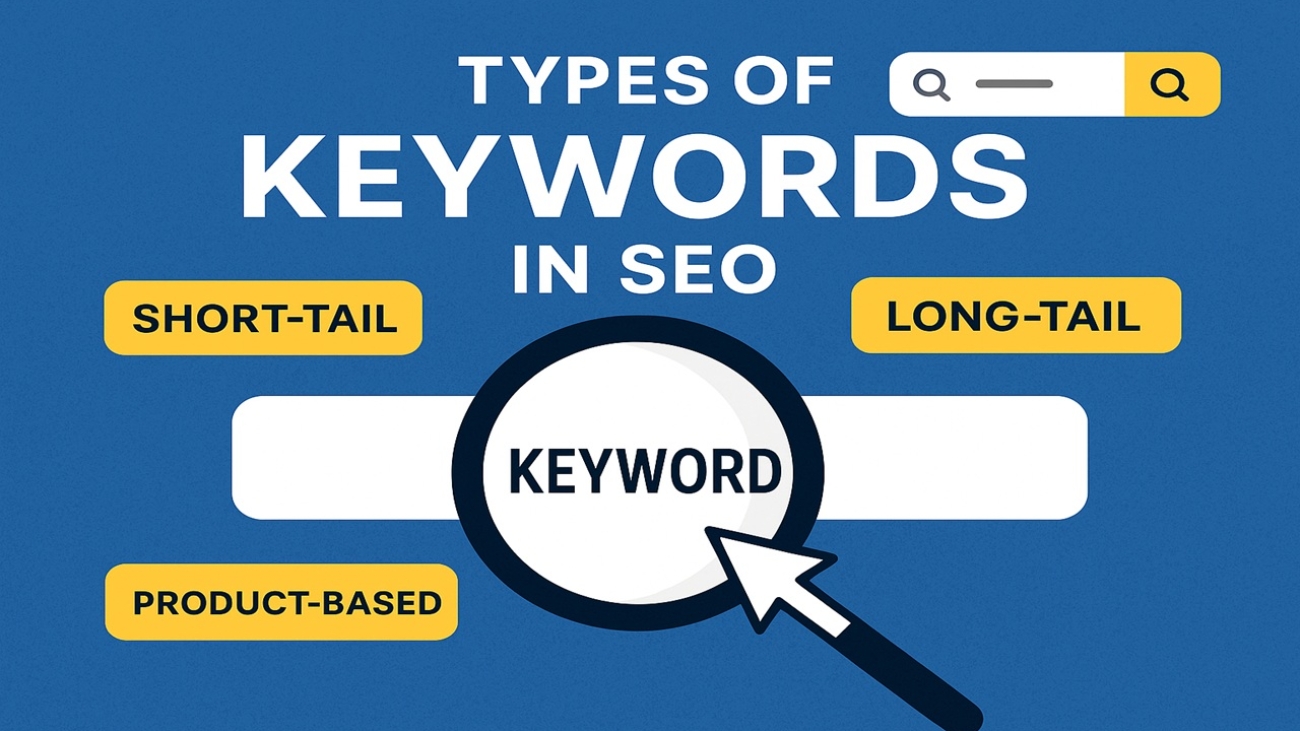
Keywords are the backbone of SEO. Without them, your content is like a store without signs; no one knows what’s inside.
Whether you’re just starting or already creating content, knowing the types of keywords helps you target the right audience and show up when they search.
Here’s the thing: not all keywords are created equal. Some bring you quick wins, others build long-term authority.
Some are broad and drive tons of traffic, while others are highly specific and bring in buyers ready to convert. If you want to play the SEO game smartly, you need to know how to use them all.
In this guide, we’ll break down the different types of keywords in SEO, why they matter, and how you can use them strategically.
By the end, you’ll not only understand what is keyword in SEO, but also how to map the right keywords to the right goals.
What Are Keywords in SEO?
Before diving into categories, let’s clarify the basics. A keyword is simply a word or phrase someone types into Google, Bing, or any other search engine.
When you search “best running shoes,” that’s a keyword. When you search “digital marketing agency in Chicago,” that’s a keyword too.
Think of keywords as the bridge between what people are looking for and the content you create. Without that bridge, your content gets lost.
If you’ve ever asked yourself, what is keyword research in SEO, it’s essentially the process of identifying the right bridges, terms your audience actually uses, so you can connect with them.
So, why should you care? Because search engines use these signals to decide which pages to show. And when you pick the right type in keyword, you position your content for visibility, traffic, and conversions.
Why Keywords Matter in SEO Strategy
It’s easy to think keywords are just about traffic. But that’s only half the story.
The right keywords attract not only visitors but the right visitors, people who are more likely to stick around, engage, and even buy.
For example, if you run an online fitness blog, targeting a broad keyword like “fitness tips” might get you visitors, but targeting something specific like “HIIT workout for beginners” brings people who actually want what you offer.
That’s the power of knowing the different types of keywords and using them strategically.
Another thing: keywords shape content structure. They help you decide what topics to cover, how to optimize your pages, and even how to structure your internal links.
If you look at any SEO keywords example from a top-performing site, you’ll notice a mix of broad, mid-level, and long-tail terms all working together.
The Main Types of Keywords
Now let’s get into the categories. Understanding the types of keywords in SEO is like having a toolbox; you need the right tool for the right job.
Here are the main groups you’ll want to master:
-
- Short-tail keywords
-
- Long-tail keywords
-
- Short-term fresh keywords
-
- Long-term evergreen keywords
-
- Geo-targeting keywords
-
- Product-based keywords
-
- Customer-defining keywords
-
- LSI (Latent Semantic Indexing) keywords
-
- Intent-based keywords
-
- Voice search keywords
Let’s break them down.
Short-Tail Keywords
Short-tail keywords, sometimes called head keywords, are usually one or two words. Think “marketing,” “shoes,” or “recipes.” They get massive search volumes, but they’re vague and highly competitive.
If you’re new, ranking for “marketing” alone is nearly impossible. But these terms help you understand broader markets. They’re like the starting point of research.
The real challenge with short-tail is intent. Someone searching for “shoes” could want running shoes, leather shoes, or even just images of shoes. So while short-tail has traffic potential, it rarely converts on its own.
Long-Tail Keywords
This is where the magic happens. Long-tail keywords are more specific phrases like “best running shoes for flat feet” or “digital marketing tips for startups.” They don’t bring as much traffic individually, but they’re gold when it comes to conversions.
Why? Because intent is clearer. Someone typing “buy iPhone 15 online” is way closer to purchasing than someone just typing “iPhone.” If you’re serious about SEO, long-tail terms should be a huge part of your content plan.
Here’s a quick pro tip: long-tail keywords are often less competitive, so you can rank faster. Even better, if you combine multiple long-tail terms in one piece of content, the traffic adds up.
Short-Term Fresh Keywords
These are trending terms that spike for a short time. Think “Black Friday deals 2025” or “Olympics schedule.” They’re hot when they’re current but fade quickly.
Fresh keywords are great if you want bursts of traffic. News sites and e-commerce stores thrive on these. The key is timing, publish too late, and you miss the wave.
If you plan ahead (like creating seasonal content or anticipating product launches), you can capture these trends before the competition.
Long-Term Evergreen Keywords
Evergreen keywords stay relevant year after year. Think “how to lose weight,” “digital marketing basics,” or “best productivity tips.” They keep bringing traffic long after you hit publish.
This is the foundation of long-term SEO success. While trendy topics fade, evergreen terms keep compounding. That’s why most blogs mix evergreen content with timely pieces; it balances short bursts with sustainable growth.
If you’re new, start with evergreen. Build a content base that lasts, then layer in fresh keywords for extra reach.
Geo-Targeting Keywords
Want local traffic? Geo-targeting keywords are your best bet. These include phrases like “plumber in Austin” or “coffee shop near me.” They connect searches to specific locations.
For businesses with physical stores or local services, these are non-negotiable. Ranking for “dentist” is hard. Ranking for “dentist in Cincinnati” is doable and more valuable.
Here’s a tip: always optimize your Google Business Profile and local listings alongside these keywords. That combo drives local search results.
Product-Based Keywords
These are keywords directly tied to a product or service. Examples: “Nike Air Max 2025” or “iPhone 15 case.” If you sell something, these are the terms that bring buyers.
Product keywords can be branded (“Apple MacBook Air”) or generic (“laptop with long battery life”). Both matter. Branded searches often mean high intent; people already know what they want.
Use product-based keywords in product descriptions, comparison pages, and review content. That’s where they shine.
Customer-Defining Keywords
These keywords describe the audience itself. For example: “workout plan for women,” “shoes for kids,” or “courses for beginners.” They’re powerful because they speak directly to who the content is for.
The more specific you are, the better the match. A generic “yoga tips” post won’t resonate as much as “yoga tips for busy moms.” Customer-defining keywords make your content feel personal and relevant.
LSI (Latent Semantic Indexing) Keywords
LSI keywords aren’t synonyms; they’re related terms search engines associate with your main topic. For example, if your keyword is “SEO,” related terms might include “backlinks,” “on-page optimization,” or “content strategy.”
These help search engines understand context. If you only repeat “SEO” without mentioning related terms, your content looks thin. But when you sprinkle in LSI keywords, you build depth and relevance.
A practical way to find them? Look at Google’s “related searches” at the bottom of the results page.
Intent-Based Keywords
Perhaps the most important category. Intent-based keywords reflect the why behind the search. They fall into three buckets:
-
- Informational: “How to start a blog”
-
- Navigational: “Facebook login”
-
- Transactional: “Buy gaming laptop online”
Understanding intent helps you map keywords to the right type of content. Informational queries need guides or blogs. Transactional queries need product pages or landing pages.
Miss intent, and your content won’t perform, no matter how well it’s optimized.
Voice Search Keywords
Voice search is changing the way people interact with search engines. Instead of typing short, choppy phrases, people speak in full sentences and natural questions. That means your keyword strategy needs to adapt.
Think about how someone types vs. how they talk:
-
- Typed: “best pizza NYC”
-
- Spoken: “Hey Google, what’s the best pizza place near me that’s open right now?”
That second one is what a voice search keyword looks like: long, conversational, and often location-based.
Here’s what makes them unique:
-
- They usually start with question words like what, how, where, when, and why
-
- They often include local intent (e.g., “near me” or “closest to me”)
-
- They’re longer, typically 5–8 words or more
Pro tip: To optimize for these types of keywords, structure your content in a Q&A format. Create FAQ sections on your pages, use natural-sounding headings, and include conversational answers.
Voice search is on the rise, and Google is prioritizing snippets that directly answer these spoken queries. If you want to future-proof your SEO, you can’t ignore this keyword category.
How to Choose the Right Keywords
With so many categories, how do you decide what to target? It comes down to balance. You want a mix of broad, long-tail, evergreen, and intent-based keywords to cover all stages of the customer journey.
Here’s a simple framework:
-
- Use short-tail for visibility.
-
- Use long-tail for conversions.
-
- Use evergreen for long-term growth.
-
- Use fresh for short bursts of attention.
-
- Use geo-targeted and product-based if you sell locally or online.
Always align your keywords with search intent. If you’re writing a how-to guide, don’t target a transactional keyword. And if you’re selling, don’t optimize only for informational queries.
How AI is Changing Keywords in SEO
Search engines aren’t dumb anymore. Forget the old days of stuffing your page with the same keyword 20 times. With artificial intelligence, Google actually understands what you’re writing about, almost like a human.
Think about Google’s BERT and MUM updates. These algorithms don’t just scan for exact matches; they process context, intent, and even relationships between words. In simple terms: Google knows when your content really answers a question, even if you don’t use the keyword word-for-word.
That changes the game. Instead of obsessing over one keyword, you now need to think in topics and intent. If someone searches “best running shoes for flat feet,” Google isn’t just looking for those exact words. It’s scanning for relevance: reviews, comparisons, arch support, and comfort.
Here’s how AI is reshaping keyword use today:
-
- Semantic Search: Google recognizes synonyms and context. (e.g., “car” and “automobile.”)
-
- Voice Search: Queries are conversational and longer. (Think: “What’s the best pizza place near me that’s open now?”)
-
- Predictive Trends: AI tools show you what people will search for, not just what they already search for.
-
- Content Gaps: AI highlights missing subtopics so you can create content clusters, not just single pages.
Bottom line: keywords aren’t dead, they’ve just evolved. Instead of chasing single phrases, build content that fully answers the user’s intent. The better you align with what people mean, the more love you’ll get from search engines.
Final Thoughts
Keywords are more than just words; they’re the foundation of online visibility. Once you understand the types of keywords, you can map them to your goals and create content that actually works.
Think of it like building a house: short-tail keywords are the blueprint, long-tail keywords are the bricks, evergreen terms are the foundation, and intent-based keywords are the rooms that make it livable. Without all of them, the structure is incomplete.
So the next time you’re planning content, don’t just pick random words. Be intentional. Mix keyword types. Match them with intent. And watch your traffic, authority, and conversions grow.
SEO is always evolving, and so are the opportunities to grow your business. At Digital Upshot, we use data, AI, and proven strategies to put your brand in front of the right audience at the right time.
Want to see how SEO can transform your business? Start here: www.digitalupshot.com/seo/
FAQs on Types of Keywords in SEO
1. What are the 4 types of SEO?
The four types of SEO are on-page SEO, off-page SEO, technical SEO, and local SEO. On-page focuses on content and SEO keywords, off-page emphasizes backlinks and authority, and technical covers site speed and structure, while local targets location-based visibility. Together, these strategies help businesses optimize for different search intents and audiences.
2. How many types of keywords do we have?
SEO keywords are classified by searcher intent (informational, navigational, commercial, transactional), length (short-tail, mid-tail, long-tail), and specificity (branded, unbranded, local, niche). Other types include LSI keywords, seed keywords, and primary/secondary keywords for structuring content. Each category supports targeting users at different stages of the buyer’s journey.
3. What are the 3 C’s of SEO?
The 3 C’s of SEO are Content, Code, and Credibility. Content refers to optimized use of keywords, Code involves technical elements like site structure, and Credibility focuses on authority through backlinks and trust signals. Balancing these ensures strong visibility in search engines.
4. What are three keywords?
Three examples of keywords are informational, navigational, and transactional. An informational keyword like “how to bake a cake” educates, a navigational keyword like “Facebook login” directs to a site, and a transactional keyword like “buy Nike Air Max” shows purchase intent. Each type aligns with specific user goals in SEO.