
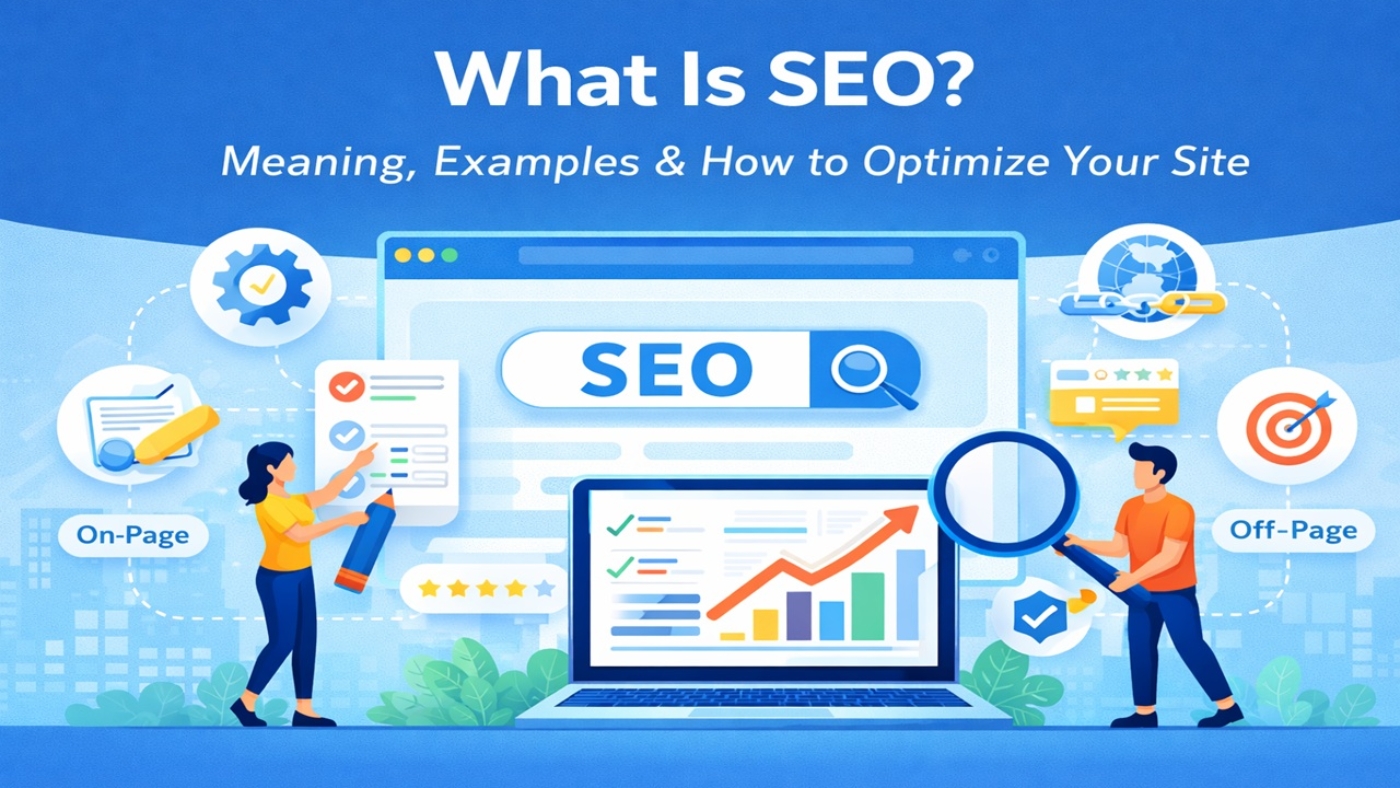
Not all websites get traffic. Some sit alive for years with barely a visit. SEO changes that. It’s how a site shows up when someone types something into a search. No shortcuts, no guessing; just structure, content, and intent lined up right.
SEO stands for Search Engine Optimization. It’s the work that helps search engines understand what your site is about and why it should rank above the rest. Done well, it gets your content in front of the right people at the right time, without depending on ads to be seen.
This guide answers the question “What is SEO, where it shows up in action, and how to optimize your own site?” clearly and step by step.
What Is SEO?
Most people first hear the term “SEO” when trying to improve their website’s visibility. It sounds technical, and in many ways, it is. But the concept itself is simple: SEO is the work that helps your site show up when people search online. You type something into Google, and the results you see? That’s the impact of SEO.
To answer the question: “What is SEO? It stands for Search Engine Optimization. It’s the process of improving your website so that search engines like Google can understand it better, rank it higher, and match it to the right queries. SEO isn’t just about being found. It’s about being found by the right audience, for the right reasons.
SEO has evolved a lot over the years. It’s no longer just keywords and links; it’s strategy, structure, content, and user experience all working together. And as search engines get smarter, good SEO has become less about gaming the system and more about serving people well.
Why SEO Matters in 2025 and Beyond
Every business, creator, or publisher who relies on traffic cares about one thing: visibility. And search engines are where most people begin when they need answers, products, or services. That makes SEO the backbone of digital visibility.
It’s not just about ranking anymore. Modern SEO influences how your brand appears, how much space it takes up on search pages, and how credible it looks. This is where search engine optimization marketing steps in; it aligns your content, structure, and technical setup with what search engines prefer and what users need.
More than ever, there’s a direct link between SEO ranking and business outcomes. Higher rankings bring more clicks. More clicks bring more opportunities to convert. It’s also one of the most cost-effective ways to reach your audience, because once your SEO is set up properly, the traffic often keeps coming without extra ad spend.
How Search Engines Work
You don’t need to be a developer to understand how Google or Bing processes your content. Every time you search for something online, there’s a system working in the background, quickly and quietly, to find the most helpful answers. That system follows a structured process: crawling, indexing, and ranking. Knowing what each of these steps involves helps explain why search engine optimization matters.
Step 1: Crawling
Search engines send out bots, also known as crawlers or spiders, to explore the web. These bots go from page to page using links, scanning everything they find, from your homepage to your blog articles to your product listings. They look at your content, your links, your layout, and even your code. If your site isn’t linked well or contains broken pages, crawlers may miss key sections entirely. That’s why solid internal linking and a clear site structure are essential for good website SEO.
Step 2: Indexing
Once the bots crawl a page, the search engine tries to understand and store what it found. This is called indexing. The index is basically a giant library where each page is filed under certain topics and keywords. If your content is easy to read, uses descriptive headings, and includes terms like what is SEO or SEO optimization naturally, it’s more likely to be stored in the right category. But if the page is confusing or slow to load, it may not make it into the index at all.
Step 3: Ranking
When someone performs a search, the engine looks through its index and ranks pages based on relevance, quality, and usefulness. This is where the algorithm gets to work. It evaluates signals like content depth, mobile performance, structured data, backlinks, and more. If your content matches the search intent and offers value in a clear format, your chances of ranking well increase. Without optimization, even well-written content can get buried under more accessible, better-structured pages.
Why This Matters
All three steps, crawling, indexing, and ranking, are connected. If search engines can’t crawl your page, they can’t index it. If it’s not indexed, it won’t rank. That’s why SEO is not just a technical checklist. It’s a way to make sure your content is discoverable and meaningful. When your site structure is clean and your content speaks clearly to real questions, you help search engines do their job better, and your visibility improves as a result.
Types of SEO: On-Page, Off-Page, and Technical
SEO isn’t one single tactic; it’s a layered approach. Each type plays a different role in how your site performs and how search engines respond to it. Some efforts happen directly on your website, others rely on external signals, and some are buried deep in the technical foundation. For a site to rank well and stay competitive, all three need to work together. Ignoring one usually weakens the rest.
On-Page SEO
On-page SEO is what you control directly on your site: titles, headers, body content, images, internal links, and metadata. If you’ve also searched for the question “what is SEO optimization?”, this is usually what people mean. It’s about making each page more accessible and relevant to both users and search engines.
Off-Page SEO
Off-page SEO is about building credibility. Think backlinks, social shares, and mentions. These elements signal to search engines that others trust your site. A strong SEO proposal often includes a backlink strategy for this reason.
Technical SEO
Technical SEO handles what happens behind the scenes: site speed, mobile responsiveness, crawlability, clean URLs, and structured data. These aren’t visible to most users, but search engines depend on them. If this foundation is weak, even great content might never show up.
This is where a service like Digital Upshot’s SEO offering makes a difference. It doesn’t just clean up a few titles or tweak metadata. It focuses on the core structure of the site. Fixing what search engines need to read, load, and rank the content properly is what should be the main focus. That backend work often becomes the reason why a site starts performing better, without making anything flashy on the surface.
Keywords and Intent: The Heart of SEO Strategy
At the center of everything is the searcher’s intent. It’s not just what they type, it’s what they mean. A good strategy aligns content with that intent, using keywords as a bridge.
You’ve likely come across terms like SEO meaning or search engine optimization definition. People type these not just to learn terms but to find clear, usable information. That’s why keyword research matters. It’s about understanding what your audience is really asking and meeting them there.
This part of SEO optimization isn’t about guessing. It’s data-driven. Tools and experience help identify which keywords matter, how competitive they are, and what kind of content is needed to match them. Done right, it doesn’t just improve visibility, it also boosts trust.
How to Optimize Your Site Step-by-Step
There’s no shortcut when it comes to getting SEO right. It’s a mix of structure, content, and performance, all working together. Instead of trying everything at once, start with the basics and get each layer right before moving on.
Here’s how that looks in practice:
1. Audit and Structure
Start by looking at how your site is built. Can a visitor get to any important page in just a few clicks? Are sections grouped logically? A clean layout with intuitive navigation helps users move around without confusion, and it makes it easier for search engines to crawl your pages. Fix any broken links, remove dead-end pages, and make sure your top content isn’t buried. A solid structure sets the stage for everything else.
2. Keyword Planning
This is where intent matters. Think about what your audience types into search when they need help or want answers. Questions like “What is SEO optimization?” or terms such as website SEO often show up during early research. Choose keywords that are specific and clearly tied to the kind of traffic you want. Avoid guessing. Use tools or search suggestions to see what real users are looking for, then shape your topics around that demand.
3. Content and Meta Tags
Content should be built around real questions and clear answers. Use headings to break up long sections and keep the flow easy to follow. If something can be scanned quickly, it’s more likely to be read. Title tags and meta descriptions should match what the page delivers. A mismatch between the headline and the body often leads to a bounce. Everything you write should help someone decide that your page is the right one to click, and the right one to stay on.
4. Technical SEO Basics
Your site has to load fast, work on all screen sizes, and stay stable as it loads. These are baseline expectations now, not bonuses. Tools like Search Console or Lighthouse can flag slow pages, crawl issues, or other problems that search engines notice. Fixing these directly impacts how pages are evaluated and ranked. Technical SEO doesn’t need to be complex; it just needs to be consistent and maintained over time.
5. Off-Page and E-E-A-T
Getting other sites to mention or link to yours is a signal that you’re worth paying attention to. This can come from guest posts, interviews, press, or mentions in trusted directories. Alongside links, show who’s behind your content. List author names, credentials, or business info clearly. These small trust markers feed into the search engine optimization definition and help establish experience, authority, and reliability in your space.
6. Track, Test, Repeat
SEO isn’t set and forget. Once changes are live, start measuring what’s working. Traffic, rankings, and conversion behavior will tell you what to keep, improve, or replace. Use analytics tools or dashboards to stay close to the data. Even a small tweak, like updating an outdated title or fixing a slow page, can improve results. Review regularly, test often, and keep refining what you build.
Content SEO vs. Structural SEO
When people talk about optimizing content, they usually think of blog posts and keywords. That’s a piece of it, but not the whole picture. Content SEO is about delivering the right message in the right format. Structural SEO is about making sure that content is framed and delivered in a way search engines can fully understand.
Content SEO
Content SEO covers everything the user sees and reads. That includes headings, body copy, internal links, image tags, and semantic formatting. Its goal is to communicate clearly while also helping search engines understand what each page is about. A blog post answering what is SEO, for example, needs to give a direct answer, follow a clear structure, and use relevant language naturally.
Well-placed keywords matter, but they’re not enough on their own. The writing needs to stay focused, useful, and organized. Sites that perform well usually combine sharp content with thoughtful placement of terms, questions, and topic signals that align with real search behavior.
Structural SEO
Structural SEO handles the foundation beneath that content. It includes how URLs are structured, how pages connect, and how hierarchy flows through the site. Elements like schema markup, breadcrumb navigation, and internal linking all help search engines map the content more accurately.
Even if the user never notices these parts, they shape how easily a site can be crawled and indexed. Without a strong structure, search engines may struggle to understand the depth or importance of what’s published.
E-E-A-T and Google’s Quality Guidelines
Ranking well is no longer just about having the right keywords or backlinks. Google now pays close attention to signals of Experience, Expertise, Authoritativeness, and Trustworthiness, together known as E-E-A-T. These qualities help search engines decide which content is reliable and which content to avoid showing for serious queries. If your site deals with topics related to health, money, safety, or business, these signals matter even more.
Here’s how each part of E-E-A-T plays a role in how your content is evaluated.
Experience: Show You’ve Actually Done the Work
Experience is about proving that the person writing the content has real, first-hand knowledge. If you’re talking about website SEO, have you worked on SEO projects? Can you speak from actual results or day-to-day challenges? Google looks for signs that the content is based on direct involvement, not just rewritten theory. Pages that show this, through screenshots, real examples, or practical steps, feel more genuine to both readers and search engines.
Expertise: Back It Up With Knowledge
Expertise is about depth. It’s one thing to answer about what is SEO optimization, it’s another to explain how it works, what tools to use, and how to apply it to different site types. Expert content answers not just the surface-level question, but also the related ones. Strong internal linking helps here. So do credentials, years of experience, or writing that clearly reflects professional understanding. Google doesn’t need a formal title, but it does expect content that reflects real mastery of the subject.
Authoritativeness: Earn Recognition From Others
Authority builds over time. It shows up when others mention your work, link to your content, or refer to your site as a go-to resource. In SEO, this might mean being featured on respected blogs, cited in guides, or listed in curated tools or directories. Authority can also come from being part of a trusted brand or organization. If your site consistently publishes useful, accurate content and others rely on it, that authority becomes visible to Google, too.
Trustworthiness: Be Transparent and Reliable
Trust is the baseline. Without it, the rest doesn’t hold up. Google wants to see clear contact details, privacy policies, secure connections (HTTPS), and honest presentation of content. Citing reliable sources, disclosing authorship, and being transparent about intent all support trust. If someone lands on your page searching for SEO meaning, they should know who wrote it, why it’s credible, and why they can rely on it.
Core Web Vitals and Page Experience
There was a time when content alone could help you rank. But not anymore. Google now evaluates how users experience your website. That’s where Core Web Vitals come in, metrics that measure loading speed, visual stability, and interactivity.
If your site loads slowly, shifts around while loading, or delays user interaction, your SEO ranking can take a hit. These aren’t just technical preferences; they reflect how frustrated or satisfied a real person feels when visiting your site.
Optimizing Core Web Vitals means prioritizing speed, mobile responsiveness, and clean design. Services like Digital Upshot’s SEO solution integrate these technical essentials into broader strategies. It’s not about patchwork fixes, it’s about making sure the whole experience supports long-term performance.
SEO for Local Businesses
Not all SEO strategies aim for national traffic. If you run a business that serves one city or region, local SEO is where your efforts should begin. It’s tailored for visibility in maps, directories, and localized search queries.
For example, if someone searches “plumber near me” or “best pizza in Andheri,” search engines prioritize local relevance. Google Business Profiles, consistent NAP info (Name, Address, Phone), and localized landing pages all matter. This form of search engine optimization marketing directly supports foot traffic and phone calls.
What makes local SEO unique is that intent is often immediate. Someone searching locally is usually ready to act. That’s why building out a local strategy is often a key part of any SEO proposal for small businesses looking to stand out in their market.
Examples of SEO in Action
Theory only goes so far. What makes SEO useful is how it’s applied to real websites with real goals. A local service business doesn’t need the same approach as an e-commerce store, and a content site plays by different rules entirely.
These examples break down how SEO works differently depending on the type of site, and how a few focused changes can lead to real results:
Local Business SEO
For a service-based business with a physical location, visibility depends on how well it’s optimized for local intent. When someone nearby searches for urgent help, like a plumbing issue, they usually use specific terms. That’s why the site should focus on location-based queries rather than broad phrases. Something like “emergency plumber in Bandra” is far more likely to match what people are actually typing into a search.
To show up for these searches, the website needs to be built with local signals in place. This includes:
- Dedicated landing pages for each service area or neighborhood
- City names are naturally placed in the page title, H1, and URL
- A Google Map embedded on the contact page
- Consistent business name, address, and phone number across all pages and directories
These signals help search engines verify where you operate and who you serve. To strengthen this further, add LocalBusiness schema markup, which tells Google about your hours, service types, and physical location in a structured way.
Customer reviews also play a big role in local SEO. Prompt happy clients to leave reviews on platforms like Google or Yelp, and then display a few of those directly on your site. They don’t just build trust with new visitors. They also support visibility in search. When content, structure, reviews, and technical detail all work together, the site becomes more relevant to local intent and more likely to show up at the exact moment someone is ready to call.
Ecommerce SEO
For online stores, SEO directly shapes how products are discovered and purchased. Every product page needs to clearly describe what’s being sold, using language that mirrors how people search.
If someone is looking for “organic face cream for dry skin,” that phrase should appear naturally in the page title, H1, and product description. This helps the product match real search queries without feeling forced.
Beyond the text, search engines also rely on visual context. Product images should have clear filenames and alt text that describe what’s shown. That’s especially useful in categories where visuals matter, like skincare, clothing, or decor. Good image SEO makes it easier for those products to surface in Google Images, where many shopping journeys begin.
Category and filter pages often get overlooked, but they’re just as critical. If those pages don’t have enough descriptive content or if the structure is unclear, they might not rank at all. To make them work:
Add short, useful copy that explains what the category covers
Keep the URL structure clean and consistent
Avoid thin or duplicate content by using unique text and canonical tags
Internal linking is another way ecommerce sites build structure. Blog posts, gift guides, or how-to articles should point directly to product pages. This gives users a better path to purchase and also signals relevance to search engines. The more connected the content, the more value it passes across the site.
All of this affects how people interact with the store. Products that are easier to find, pages that load quickly, and navigation that works across devices all contribute to better performance. That’s how ecommerce SEO supports conversions, not just by bringing people in, but by helping them complete the journey once they’re there.
Educational Blog SEO
Informational blogs do well when they match what people are actively searching for. Long-form content that answers questions clearly tends to perform best, especially for topics that need explanation.
When someone looks up “what is SEO optimization?” or SEO meaning, they’re looking for a straightforward answer. The blog post that delivers it in plain language, with a clean heading structure, is the one that usually earns top positions.
These types of queries often trigger featured snippets or “People Also Ask” sections, which puts extra weight on structure and clarity. Formatting matters. If a user can scan the page and find what they need without digging, that page has a better chance of ranking. To support that, content should focus on:
Definition Placement: Add the core answer or meaning near the top, ideally in the opening paragraph.
Clean Headings: Use direct, descriptive H2s and H3s that map to specific search queries.
Answer First: Keep explanations brief and to the point before expanding further down the page.
Targeted FAQs: Include short FAQ sections that address related queries without repeating the main content.
To build topical relevance, internal links play a key role. For example, a post that explains the search engine optimization definition can naturally connect to related articles, like guides on keyword planning, on-page structure, or technical cleanups. Linking between these pages helps search engines map out the site and understand its depth. It also gives the reader a reason to stick around.
This kind of structure does more than improve rankings. It increases time on site, reduces bounce, and supports a consistent experience across the blog. Over time, it becomes easier for search engines to trust the content, which leads to better placement without needing to chase every new trend or algorithm update.
AI, Chatbots, and the Future of SEO
Search has always adapted to how people use the internet. But the shift brought by AI and conversational tools is bigger than just a new feature. It’s changing what people expect from search and how search engines deliver it. Instead of clicking through multiple results, users now get answers directly, summarized, contextual, and fast. That change has real implications for how content is created, optimized, and surfaced. It doesn’t replace SEO. It changes its shape.
Here’s how AI is shifting the landscape and what it means for SEO moving forward.
How Search Is Changing
Search habits have evolved. People no longer rely only on typing short phrases into a search bar. Now they ask questions using voice assistants, interact with chatbots, or receive quick answers from AI-driven features. This shift hasn’t made SEO less relevant; it has made it more demanding. Being visible today means understanding how users interact with content across different formats and platforms.
The Rise of Generative Search
Tools like Google’s Search Generative Experience (SGE) and Bing’s AI results are reshaping what a search page looks like. Instead of showing a list of links, these tools pull key insights from top pages and summarize them instantly. If your content isn’t chosen for that summary, even a high ranking may not get you seen. This makes content quality, formatting, and clarity more important than ever.
Why Structure Matters More Than Ever
To stay visible in this new format, your pages need to be machine-friendly. That means clear headings, clean formatting, and structured data that helps AI understand what your content offers. It’s not just about using the right keywords. It’s about showing relevance through layout, topic clarity, and internal logic. If AI tools can’t follow the flow of your content, they won’t use it in generated answers.
Optimizing for Human and Machine
Queries like “What is SEO optimization?” or “How does website SEO work?” now require direct, focused answers. The content has to work for both human readers and AI systems scanning for useful blocks of information. That includes short summaries, question-based headings, and supporting sections that build on each other. The better your structure, the more likely your content becomes part of a result, even when no link is clicked.
SEO Isn’t Dying, It’s Expanding
AI tools aren’t replacing SEO. They’re changing what it includes. Today, SEO goes beyond keywords and backlinks. It covers how content is framed, how it reads, how fast it loads, and how users interact with it. The signals sent by time on page, bounce rate, and user engagement all feed into how search systems rank and surface content. Good SEO now means designing content that works across both human attention and machine interpretation.
Voice, Image, and Multimodal SEO
Search isn’t just typed anymore. People are using voice assistants, scanning images, and combining multiple search methods across platforms. That’s what makes multimodal SEO the next big thing.
Voice search requires content that answers questions clearly and directly. For example, someone might ask, “What’s the SEO meaning for a small business?” Your content has to be phrased in a way that devices can extract and read aloud.
Image search, meanwhile, is growing in shopping and design-related niches. Search engines analyze image names, alt text, and surrounding content to understand what an image shows. Optimizing for these new formats is quickly becoming part of standard SEO optimization practices for brands who want to stay visible.
Common SEO Mistakes to Avoid
Even the most experienced teams miss things when it comes to SEO. That’s partly because the landscape changes quickly, but also because many mistakes come from overthinking simple things. Whether you’re managing content, planning a new campaign, or reviewing a website SEO strategy, these are the issues that show up again and again. The good news is that fixing them often makes a bigger difference than people expect.
Keyword Stuffing Still Happens
The temptation to use the same keyword multiple times is real. But repeating a term in every heading or stuffing it into every paragraph doesn’t improve rankings. It hurts them. Search engines can tell when the writing feels forced or unnatural. It also makes the content harder to read. Instead, it’s better to focus on clarity, use related terms, and write for the reader first. A page that feels useful will always perform better than one that’s trying too hard to rank.
Weak or Confusing Structure
Your content can be well-written, but if the structure is a mess, it won’t rank well. Pages without internal links, unclear heading levels, or broken navigation create a bad experience for users and crawlers. This is one of the most common issues found during a technical audit. When search engines can’t understand how pages connect, or worse, can’t reach them at all, your visibility takes a hit. Every good SEO proposal should include a plan to clean up and strengthen the site structure.
Letting Content Go Stale
Search engines favor pages that are fresh, reliable, and updated. Leaving old content untouched for years is a missed opportunity. Something as simple as refreshing stats, adding a few new sections, or improving formatting can help a page regain traction. Sites that regularly update their content often see better SEO ranking across the board.
Ignoring Mobile Optimization
With most traffic coming from mobile devices, a site that looks or performs poorly on a phone is at a major disadvantage. Pages that don’t adapt well to different screen sizes, load slowly, or cause layout shifts will struggle to meet performance standards like Core Web Vitals. These issues aren’t always obvious from a desktop. That’s why every serious SEO review should include mobile testing.
Final Thoughts
SEO isn’t magic, it’s a method. It’s the result of aligning content, structure, and performance with how people search and how algorithms sort. While strategies evolve, the fundamentals stay consistent: relevance, clarity, and quality win every time.
If you’re working on your website SEO, remember that small changes often compound. Page speed, internal links, updated content, and better structure all add up. The question isn’t just “why is search engine optimization important?”, but how consistently it’s done.
You don’t have to go it alone. Platforms like Digital Upshot have taken a grounded, methodical approach to SEO, quietly helping businesses refine their presence without shortcuts. Their approach shows that proper SEO isn’t about chasing trends; it’s about building strong foundations that hold up long-term.
FAQs on What is SEO
What are the 4 pillars of SEO?
The four pillars of SEO are technical SEO, on-page SEO, content, and off-page SEO. Each one supports how your site performs in search results. Technical SEO focuses on things like site speed and mobile usability. On-page SEO covers how well your pages are structured. Content speaks to what’s written on the site. Off-page SEO includes backlinks and overall credibility.
What are examples of SEO techniques?
Common SEO techniques include optimizing title tags, adding internal links, improving page speed, using structured data, and writing content around relevant keywords. Updating old content, improving mobile design, and earning backlinks from trusted sites also make a big impact.
What is an example of SEO in real life?
Say you run a bakery in Delhi. If someone types “best chocolate cake near me” and your website shows up at the top, that’s SEO in action. It means your site had the right keywords, structure, and local signals to match what people were looking for.
What are the four types of SEO?
The four types are on-page SEO, off-page SEO, technical SEO, and local SEO. On-page focuses on the content itself. Off-page is about building authority through backlinks. Technical SEO makes sure your site runs smoothly. Local SEO helps you appear in results tied to a specific area.
Which tool is best for SEO?
There isn’t just one tool that covers everything. Google Search Console is a must for tracking performance. Tools like Ahrefs, SEMrush, or Ubersuggest help with keyword research, backlinks, and competitor analysis. Each tool has its strengths depending on what you’re working on.
What are the 4 C’s of SEO?
The 4 C’s stand for Content, Code, Credibility, and Context. Content refers to what you’re saying. Code covers the technical setup of your site. Credibility means your trust signals and backlinks. Context is how well your content fits user intent and search relevance.
Which type of SEO is best?
The best type of SEO is the one that fits your goal. For most websites, combining technical, on-page, and content SEO is key. If you run a local business, local SEO matters more. For online brands, content and link-building take the lead.
Which language is best for SEO?
There’s no single best language for SEO. English dominates global search, but it depends on your target audience. The important part is how clearly and naturally your content is written. Clean HTML code, fast load times, and structured content work well in any language.