
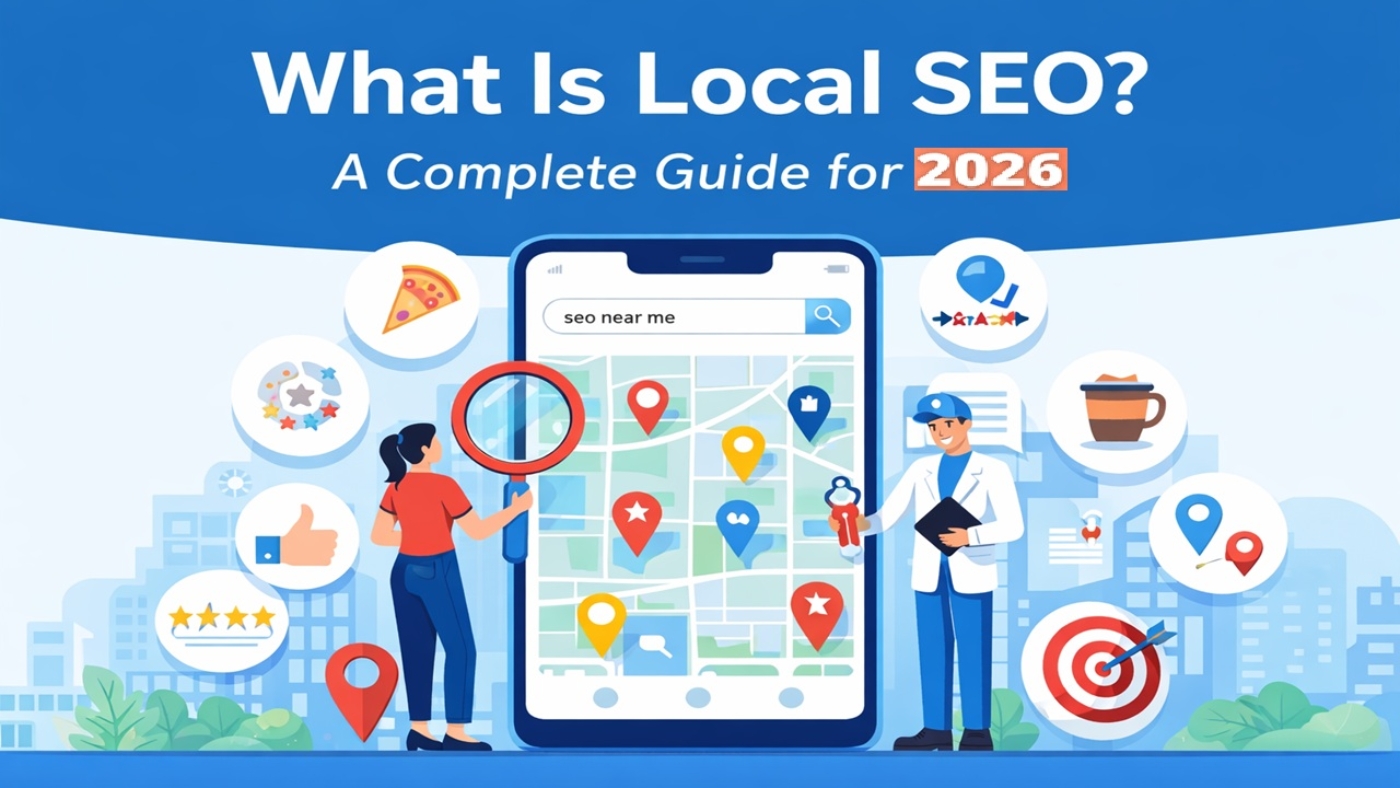
When was the last time you searched “coffee shop near me” or “plumber open now” on your phone?
Chances are, you weren’t just browsing. You were ready to visit or call a business nearby. That’s the power of local search, and it’s where Local SEO comes in.
In 2026, the answer to the question “What is local SEO?” isn’t just a buzzword. It’s the difference between being discovered by ready-to-buy customers or being invisible in your own neighborhood.
Let’s break down why it matters now more than ever, and how businesses can make the most of it.
What Is Local SEO?
So, what is local SEO exactly? At its core, Local SEO is the process of optimizing your business to appear in location-based searches on platforms like Google Search and Google Maps.
If someone nearby types in “dentist near me,” the results they see are shaped by how well those practices have invested in local search optimization.
Unlike broad SEO strategies that target global or national audiences, local business SEO focuses on driving foot traffic, calls, and leads from customers in your immediate area.
Google uses three main factors, like relevance, distance, and prominence, to decide which businesses appear first. That means your online presence needs to reflect accurate, consistent, and trustworthy information across the web.
Why Local SEO Matters in 2026
Think about your own habits. If you’re hungry, you pull out your phone and type “pizza near me.” You don’t want to scroll through national chains; you want the best slice a few blocks away.
That’s why what is local SEO is such a big deal: it connects intent with action.
Here are a few numbers to paint the picture:
- 99% of people search online to find local businesses
- Nearly 80% of local searches result in a purchase
- “Near me” searches have grown more than 900% in recent years
Trust is also tied directly to visibility. Customers lean heavily on reviews and accurate business information. Over 80% of users trust Google reviews as much as personal recommendations.
If your listing isn’t optimized, you could miss out on traffic that’s ready to convert. And in 2026, with AI search results reshaping how people find businesses, local SEO marketing plays an even bigger role in helping companies appear in generative, conversational searches.
Core Elements of an Effective Local SEO Strategy
To dominate your local market in 2026, you need more than luck; you need a strategy built around the essentials of what is local SEO. Each piece of the puzzle works together to improve visibility, build trust, and attract high-intent customers ready to buy.
Let’s break down the core elements and how you can leverage them effectively:
Google Business Profile (GBP)
Your Google Business Profile is the foundation of local business SEO. When someone searches for a service in your area, the local pack, including the map and top three results, is often the first thing they see. If your profile isn’t optimized, you’re invisible in the most valuable real estate of search.
To maximize your GBP:
- Add complete business information (hours, phone number, website, services, and attributes)
- Upload high-quality photos of your location, products, or team
- Post weekly updates or promotions to show activity
- Respond promptly to all customer reviews, positive or negative
Think of your GBP as your digital storefront. If it looks empty or outdated, customers will skip past you. But if it’s detailed, engaging, and up-to-date, it becomes the first “yes” in their buying decision.
Local Keyword Optimization
Keywords are still the backbone of SEO, but local searches behave differently. People don’t just type “pizza”; they type “best pizza near me open now.” That’s why your strategy must adapt to conversational, intent-driven queries.
This is where knowing the answer to “What is local SEO optimization?” becomes critical. It means weaving location-based terms into headers, page titles, meta descriptions, and even image alt text. But it’s not about repetition; it’s about relevance.
Action steps:
- Use tools like Google Keyword Planner or Semrush to uncover local variations of your services
- Create location-specific landing pages (e.g., “Plumbing Services in Downtown Chicago”)
- Include nearby landmarks, neighborhoods, or city names to align with how real users search
The goal is to speak the same language your customers use when they’re ready to buy. Done right, you’ll rank not just in organic results but in map packs too.
Reviews and Reputation
Word-of-mouth has moved online. Today, 87% of people read reviews before engaging with a business, and over 70% won’t even consider companies with fewer than three stars. That makes reputation a ranking factor as well as a trust signal.
Reviews impact:
- Ranking: Google uses reviews as a local pack ranking factor
- Conversions: Positive reviews build instant credibility
- Engagement: Responding shows you value feedback, which boosts trust
Action steps:
- Make review requests part of your customer experience after a purchase, service, or appointment
- Use QR codes or direct links to simplify the process
- Respond to every review, whether it’s praise or criticism, to show engagement
Remember, a mix of reviews, even some constructive ones, can look more authentic than a page of only five-star ratings.
Citations and Backlinks
Citations are mentions of your business details (NAP: name, address, phone) on directories, apps, or websites. Consistency is key here. If your business is listed as “Main Street Pizza” in one place and “Main St. Pizza Co.” in another, search engines may treat them as different businesses, hurting trust.
Action steps for citations:
- Audit your listings across Google, Bing, Yelp, Apple Maps, and niche directories
- Correct inconsistencies and keep them updated
- Use citation management tools for scalability
Backlinks, meanwhile, are digital endorsements. When local organizations, newspapers, or bloggers link to you, it boosts your authority. Unlike national SEO, the focus here should be on relevance and proximity.
Ideas for local backlinks:
- Partner with local charities or events for sponsorship mentions
- Collaborate with local bloggers or influencers
- Submit stories to local media outlets about business milestones
Think of backlinks as community connections in digital form. The stronger your ties, the stronger your authority.
Analytics and Tools
“If you can’t measure it, you can’t improve it.” That’s especially true in Local SEO. Tracking performance shows not only what’s working but also where to pivot.
Key metrics to monitor:
- Local pack impressions and clicks
- Website traffic from local queries
- Calls, direction requests, and bookings from your GBP
- Review volume and response rates
Tools that help:
- Google Analytics: Track behavior and conversions from local traffic.
- Google Search Console: See which queries drive clicks and impressions.
- Local SEO platforms (like Semrush Local): Monitor map rankings, reviews, and citations.
Consistently reviewing performance data allows you to focus on strategies that deliver strong ROI while fine-tuning those that show weaker results.
In short, the five pillars, which are Google Business Profile, local keyword optimization, reviews, citations, and analytics, form the foundation of what is local SEO. Nail these consistently, and you won’t just show up in search; you’ll own your local market.
Emerging Trends in Local SEO for 2026
The local search landscape doesn’t stand still. Consumer behavior, search technology, and platforms evolve every year, and 2026 is no different. To keep winning, businesses must anticipate where local search is going rather than only reacting after the fact.
Here are the biggest trends shaping the future of what is local SEO and how you can adapt:
Voice Search and Conversational Queries
Picture this: a busy parent driving home asks, “Hey Siri, where’s the nearest urgent care?” or a college student tells Google Assistant, “Find me a 24-hour coffee shop.” Voice-driven searches have skyrocketed, and by 2025, it’s expected that more than half of all mobile searches will be voice-based.
Unlike typed searches, voice queries are longer and more conversational. Instead of typing “dentist near me,” people say, “Who is the best-rated dentist open right now near downtown?” This subtle difference impacts keyword strategy.
Businesses need to optimize content for natural, question-based language while ensuring details like hours, services, and location are clear and crawlable.
Actionable takeaway: Add conversational FAQs to your site, use structured data to mark up business information, and make sure your Google Business Profile reflects real-time details like holiday hours or updated services. Early adopters will capture the growing share of voice-first traffic.
AI-Powered and Generative Search
Search is no longer just a list of links, as it’s becoming an experience. With Google’s Search Generative Experience (SGE), Bing’s AI chat, and the rise of AI assistants, people are getting direct answers rather than browsing through ten blue links.
Exploring “What is local SEO marketing?” reveals how it continues to evolve into a broader digital growth strategy. Businesses must create content that AI systems recognize as authoritative, accurate, and context-rich. For local companies, that means clear descriptions of services, customer-focused answers, and verified data across profiles and citations.
Imagine a customer asking ChatGPT, “What’s the best pizza place open late near me?” If your restaurant has detailed, trustworthy info online, AI-generated results are more likely to include you.
Actionable takeaway: Write content that directly answers customer questions, maintain consistent NAP data across platforms, and leverage schema markup to feed AI-driven search with structured, machine-readable business info.
Mobile-First and User Experience
Over 60% of local searches happen on smartphones, and Google has fully shifted to mobile-first indexing. That means your mobile site isn’t just a nice-to-have; it’s the primary version Google uses to evaluate relevance and ranking.
A slow-loading, clunky mobile site can destroy visibility and conversions. Customers searching “near me” aren’t patient; they want answers fast.
Page speed, responsive design, click-to-call buttons, and easy navigation directly influence whether they engage or bounce.
Actionable takeaway: Run speed audits with tools like PageSpeed Insights, add mobile-friendly features such as sticky “call now” buttons, and simplify your design to eliminate unnecessary friction. A better user experience not only boosts rankings but also improves conversions from high-intent local visitors.
Expanding Platforms Beyond Google
For years, Google dominated local search. But in 2026, relying on Google alone is risky. Platforms like Apple Maps, Apple Business Connect, Bing Places, and even niche apps like Yelp or Waze are gaining traction.
Apple’s ecosystem, in particular through Siri, CarPlay, and iOS Maps, makes it critical for businesses to claim and optimize their Apple Business Connect profile.
If you’re only optimized for Google, you’re missing segments of customers who rely on Apple devices or alternative platforms. Expanding your visibility ensures you don’t lose traffic to competitors who are present everywhere your customers look.
Actionable takeaway: Claim and optimize profiles on Apple Business Connect, Bing Places, and major directories relevant to your industry. Keep branding, hours, and services consistent across platforms.
People-First Content (E-E-A-T)
Google’s algorithm updates consistently push for quality, not quantity. That’s why local SEO optimization is no longer about cramming in keywords. It’s about delivering useful, people-first content backed by experience, expertise, authority, and trust (E-E-A-T).
For local businesses, this means creating content that speaks directly to community needs. Instead of generic blog posts, focus on helpful resources: guides to neighborhood events, tips for homeowners in your city, or detailed breakdowns of your services with pricing transparency.
Reviews, testimonials, and case studies also count as user-generated signals of trust. Google favors businesses that prove their credibility with authentic customer voices.
Actionable takeaway: Develop localized content that answers real customer questions, showcase expertise with case studies or community involvement, and encourage satisfied clients to leave detailed reviews. This approach strengthens both your brand authority and local rankings.
In short, the future of what is local SEO is dynamic and multi-channel. Voice, AI, mobile, and people-first content aren’t trends to watch; they’re realities to embrace now. Businesses that act early will own local visibility in 2026 and beyond.
Measuring Success and ROI
How do you know your Local SEO efforts are paying off? Start with metrics that directly reflect customer actions:
- Requests for guidance and calls from Google Business Profile
- Impressions and clicks in the local pack
- Website visits from local queries
- Conversion rates tied to foot traffic or local leads
A robust Local SEO campaign ties activity to outcomes. Instead of vanity metrics, focus on ROI, like how many local searches actually turned into store visits or service bookings.
Final Thoughts
So, what is local SEO in 2026? It’s more than just ranking in search results. It’s about connecting with real people in your community who are ready to buy now. Every little thing, from improving your Google Business Profile to obtaining positive reviews, adds to your exposure and credibility.
With AI-driven search, mobile-first users, and skyrocketing “near me” intent, Local SEO is no longer optional
It’s the bridge between being found and being forgotten. Invest in it today, and your business won’t just show up; it’ll stand out.
FAQs on Local SEO
Why is local SEO important in 2025?
Local SEO is the strategy of optimizing your online presence to rank higher in localized search results, especially “near me” queries. In 2026, it’s critical because it connects businesses directly with nearby customers at the exact moment they’re ready to buy. This not only drives local traffic and leads but also supports AI-driven and voice search experiences that dominate the digital landscape.
What is the future of local SEO?
The future of Local SEO lies in adapting to AI-powered search, voice assistants, and hyper-personalized experiences. Businesses will need to focus on Google Business Profile optimization, customer reviews, and location-specific content to stay visible. As search becomes more conversational, local SEO will evolve to meet users where and how they search.
What is the SEO plan for 2026?
An effective SEO plan for 2025 includes strong local SEO strategies like optimizing your Google Business Profile, building local citations, and creating mobile-first, location-based content. Businesses must also integrate AI tools for keyword insights and voice search optimization. The goal is to capture intent-driven, local customers and convert them into long-term revenue.
What is a 3 month SEO strategy?
A 3-month SEO strategy should start with an audit of your current site and Google Business Profile, followed by keyword research and technical fixes. Next, focus on local SEO efforts like building citations, encouraging reviews, and creating location-specific landing pages. In the final phase, track performance and refine content to maximize rankings and conversions.
What is AI for SEO in 2026?
AI for SEO in 2026 is about leveraging machine learning and generative search tools to deliver personalized, conversational results. For local SEO, this means preparing content that aligns with natural language queries and ensures visibility in AI-driven answers. Businesses that adapt will dominate both traditional search results and AI-curated recommendations.
What is the difference between SEO and AEO?
SEO focuses on optimizing websites to rank higher in search engine results, targeting keywords and user intent. AEO (Answer Engine Optimization) is about preparing content for AI-driven tools and voice assistants that deliver direct answers instead of links. While SEO attracts traffic through rankings, AEO ensures your content is chosen as the most relevant answer.